TextStyle and DefaultTextStyle
Purpose
A style as a value: shared, merged, or given to a whole subtree.
Signature
pub struct TextStyle { .. }

impl TextStyle {
    pub const fn new(size: f32) -> Self;
}
pub struct DefaultTextStyle { .. }

impl DefaultTextStyle {
    pub const fn from_text_style(style: TextStyle) -> Self;
}
Example
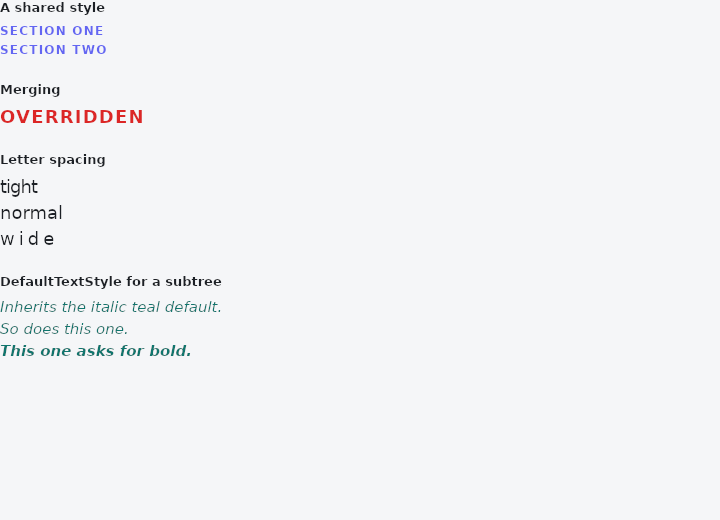
From frus-examples/widgets/src/features/text/widgets/text_style.rs:
//! `TextStyle` — a style as a value: define it once, share it, merge it, and hand it to
//! `Text::styled`, a `TextSpan` or a whole subtree with `DefaultTextStyle`.
//!
//! Every field of a style is optional. A style that only says "size 20" leaves the
//! weight and colour to whatever is around it — which is what makes styles layer.

use frus::{
    Align, Color, Column, DefaultTextStyle, FontWeight, Text, TextAlign, TextStyle, Widget,
};

use crate::common::shared::{section, sections};

/// A style shared by several texts: a `const`, since every builder is `const fn`.
const LABEL: TextStyle = TextStyle::new(12.0)
    .weight(FontWeight::SemiBold)
    .letter_spacing(1.2)
    .color(Color::rgb(0.39, 0.40, 0.95));

pub fn example() -> Box<dyn Widget> {
    sections(vec![
        // `Text::styled` takes a whole style at once.
        Box::new(section(
            "A shared style",
            Column::new()
                .cross_axis_alignment(Align::Start)
                .spacing(4.0)
                .child(Text::styled("SECTION ONE", LABEL))
                .child(Text::styled("SECTION TWO", LABEL)),
        )),
        // `merge` lays one style over another: what the second says wins, what it leaves
        // open is kept. Here, the label made bigger and red.
        Box::new(section(
            "Merging",
            Text::styled(
                "OVERRIDDEN",
                LABEL.merge(TextStyle::new(18.0).color(Color::hex("#DC2626"))),
            ),
        )),
        // Letter spacing and line height are part of the style.
        Box::new(section(
            "Letter spacing",
            Column::new()
                .cross_axis_alignment(Align::Start)
                .spacing(4.0)
                .child(Text::styled(
                    "tight",
                    TextStyle::new(18.0).letter_spacing(-1.0),
                ))
                .child(Text::styled("normal", TextStyle::new(18.0)))
                .child(Text::styled(
                    "wide",
                    TextStyle::new(18.0).letter_spacing(4.0),
                )),
        )),
        // `DefaultTextStyle::around` gives every text in a subtree a default — the way a
        // card or a toolbar styles all its text at once. A text's own settings still win.
        Box::new(section(
            "DefaultTextStyle for a subtree",
            DefaultTextStyle {
                style: TextStyle::new(15.0).italic().color(Color::hex("#0F766E")),
                align: Some(TextAlign::Start),
                ..DefaultTextStyle::NONE
            }
            .around(
                Column::new()
                    .cross_axis_alignment(Align::Start)
                    .spacing(4.0)
                    .child(Text::new("Inherits the italic teal default."))
                    .child(Text::new("So does this one."))
                    .child(Text::new("This one asks for bold.").weight(FontWeight::Bold)),
            ),
        )),
    ])
}
Properties
| Type | Method | Argument | Effect |
|---|---|---|---|
TextStyle | .weight() | weight: FontWeight | Sets the weight. |
TextStyle | .italic() | — | Switches to italic. |
TextStyle | .size() | size: f32 | Sets the size. |
TextStyle | .color() | color: Color | Sets the colour. |
TextStyle | .decoration() | decoration: TextDecoration | Sets the decoration lines. |
TextStyle | .underline() | — | Adds an underline, combining with any other decoration this style already carries — never with an inherited one, which this style cannot see. |
TextStyle | .strikethrough() | — | Adds a strikethrough, combining with any other decoration this style carries. |
TextStyle | .decoration_color() | color: Color | Sets the decoration colour; otherwise the text's colour is used. |
TextStyle | .height() | height: f32 | Sets the line's height, as a multiple of the font size — 2.0 is double leading, not two pixels. See the field for why it is a ratio. |
TextStyle | .family() | family: FontFamily | Names the font family. See the field for the one case where a named family does not get the last word. |
TextStyle | .letter_spacing() | spacing: f32 | Sets the room added after every character, in logical pixels; negative draws them closer. See the field. |
TextStyle | .clamp_scale() | max_scale: f32 | Every question answered: the framework's own default wherever nothing in the chain said anything, and the reader's font size applied. |
DefaultTextStyle | .merge() | over: Self | This style with over's answers laid on top, field by field: where over said nothing, this one's answer survives. |
Behaviour
TextStyle
The typographic attributes of a single line of text — every field optional.
None is not a missing value but an answer: this style does not say.
It matters more than it looks. TextStyle::new(20.0) says a size and nothing else, so a text wearing it still takes its weight from whatever subtree it is in. Before this was optional, a style named all three at once and size 20, inherit the weight was simply not expressible.
Ask TextStyle::resolved for the concrete numbers to measure and draw with.
DefaultTextStyle
It carried its own copy of every typographic field until TextStyle learned to say unset; now the style is just a style.
A Text resolves what the caller said ?? what this says ?? what the framework ships, field by field, and a default the caller did not choose does not count as having said something — which is what an Option per field means and what TextStyle::new(16.0) could not express.
DefaultTextStyle::around wraps a subtree with one, and that is how AppBar::toolbar_text_style delivers its own.
See also
- Text: a run of text: size, weight, colour, decoration, alignment, wrapping, line limits.
- RichText & TextSpan: one paragraph in several styles, from a tree of spans.
- Text theme: the app's type scale, from display_large to label_small, and headings.
- FontFamily: sans-serif, serif, monospace, or a font registered by name.
- The guide: Text, colour and the theme
- API reference:
TextStyle - API reference:
DefaultTextStyle
Source: crates/frus-core/src/text_style.rs, crates/frus-widgets/src/widgettheme.rs @ e6fba33f5b42